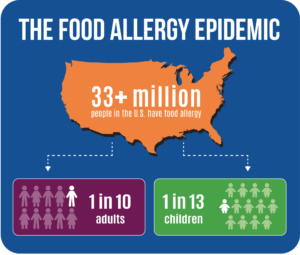
- Food allergy is a serious immune-mediated disease affecting more than 33 million people in the United States, across all regions and demographic groups, and can cause life-threatening anaphylactic reactions.
- Data shows that the overall burden of food allergy in the U.S. is substantial and growing, with some populations are disproportionately affected.
- Epinephrine remains the only emergency treatment that can stop an anaphylactic reaction.
- Support and funding for food allergy research lags far behind other immune diseases, such as asthma and cancer, despite food allergy affecting more people in the U.S.
- Progress is being made in developing better diagnostic options, innovative therapies, and stronger support systems for patients with food allergy and their caregivers.
- Pursuing a cure will require bold initiative and collaboration across scientific disciplines.
State by State: How Many People Are Living With Food Allergy?
Estimated number of people in each state currently living with food allergy.1,2